
Osceola County Criminal Court Cases
Florida divides trial work by offense level. The Ninth Judicial Circuit's Circuit Court hears Osceola felony cases. Osceola County Court hears misdemeanors and criminal traffic charges. Both use the Clerk of the Circuit Court and County Comptroller as the keeper of dockets, filed papers, judgments, and certified copies. Florida abolished ordinary municipal courts, so neither Kissimmee nor St. Cloud maintains a separate city criminal docket for state offenses. City code enforcement is a different process.
Case numbers help identify the lane. “CF” commonly marks a circuit felony file, “MM” a misdemeanor file, and “CT” criminal traffic. Those codes are useful filters, but the docket remains the authority for the actual case type and status. One arrest may also lead to no filed case, a different filed charge, or several counts with different outcomes. That is why a booking charge should not be copied into a court-history note without checking the filed information and disposition.
Osceola Felony and Misdemeanor Courts
The two trial levels share the courthouse complex at 2 Courthouse Square in Kissimmee, but their roles differ. Circuit Court handles felony prosecutions. County Court handles misdemeanor and criminal traffic files. The Clerk's criminal records counter serves both, so the best request identifies the division, case number, defendant's full name at arrest, and year.
| Office | Record held | Contact |
|---|---|---|
| Ninth Judicial Circuit | Felony court cases | 407-742-2400 |
| Osceola County Court | Misdemeanor and criminal traffic | 407-742-2400 |
| Clerk Criminal Records | Dockets, copies, certifications | 407-742-3500; search clerk 407-742-3650 |
| Clerk case information | Case and court-date questions | 407-742-3566 |
The Clerk's criminal court page shows the local entry point for these services.
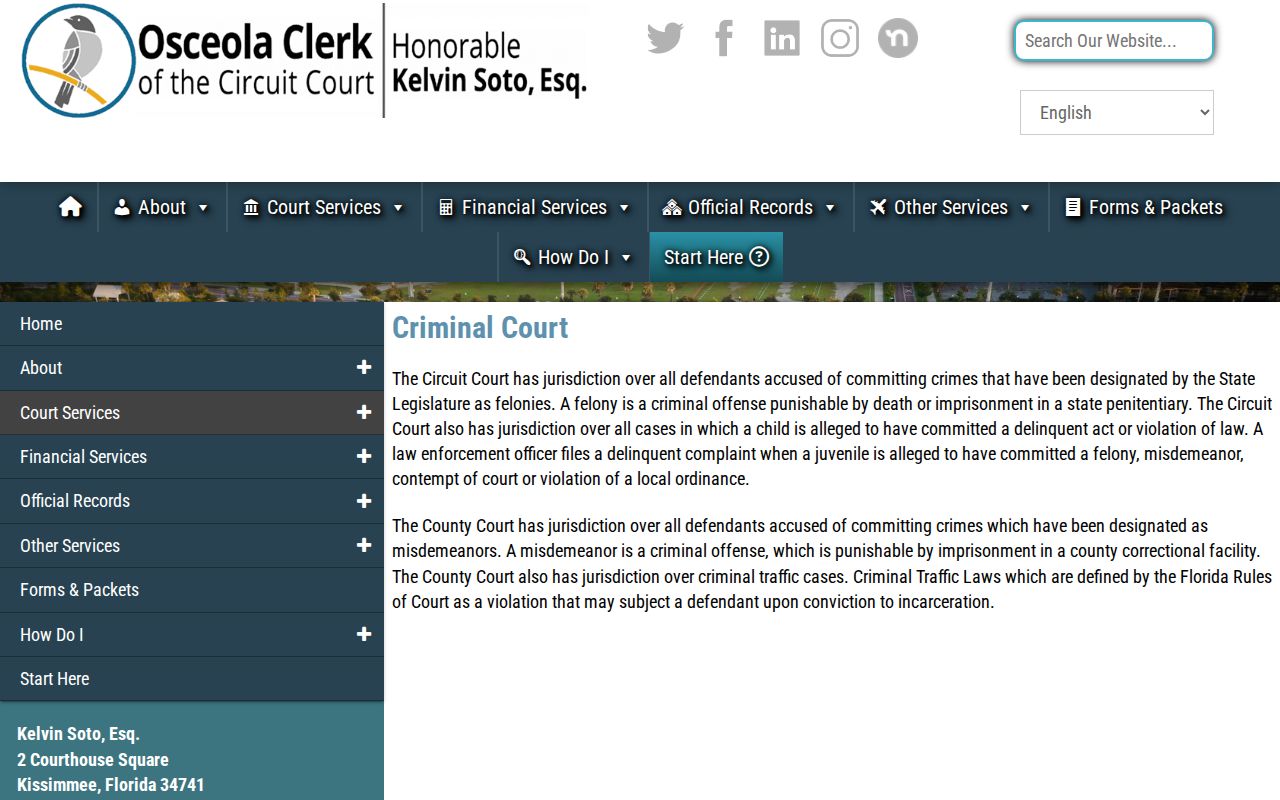
Its service links keep felony and misdemeanor requests with the same county custodian.
Searching Osceola County Case Records
Start with the Clerk's official Search Court Records service. Party-name searching helps when no case number is known. Use the legal surname at the time of arrest and add first or middle name details to reduce false matches. A direct case-number search is better when a notice or prior docket entry supplies it. Review every candidate before treating it as a match.
- Open the Clerk search and select a party or case-number route.
- Enter the surname and given name, or the complete Osceola case number.
- Narrow the results by filed year and criminal case category when those controls appear.
- Open a candidate and compare the case type, filing date, parties, and count details.
- Read the docket in date order, then request a plain or certified copy from the Clerk if proof is needed.
| Field Label | Type | Required | Notes |
|---|---|---|---|
| Search type | Tab or control | Yes | Party/name or case number |
| Last or business name | Text | For name search | Try former names separately |
| First and middle name | Text | No | Narrows common surnames |
| Case number | Text | For case search | County code 49; CF and MM are common criminal codes |
| Filed date and category | Date/select | No | Useful when the offense year is known |
Osceola Clerk Record Requests
A portal result is not the only access path. The Clerk's Criminal Records Request form accepts a complete name at arrest, a case number when known, and the years to search. State the exact document and whether certification is needed. Send it to recordsrequest@osceolaclerk.org, fax it to 407-742-3610, or mail it to Clerk of Court, Attn: Criminal Records Request, 2 Courthouse Square, Suite 2000, Kissimmee, FL 34741.
Staff first calculates the fee, and payment comes before the search. The Clerk accepts cash or money order, not personal checks, for this process. Allow seven to ten business days. Each unknown offense year can add a search charge. The result covers Osceola County only and omits sealed or expunged records. At the counter, ask whether a restricted online image can be inspected lawfully in another format.
The Sheriff's records page is a separate route for sheriff-created reports.
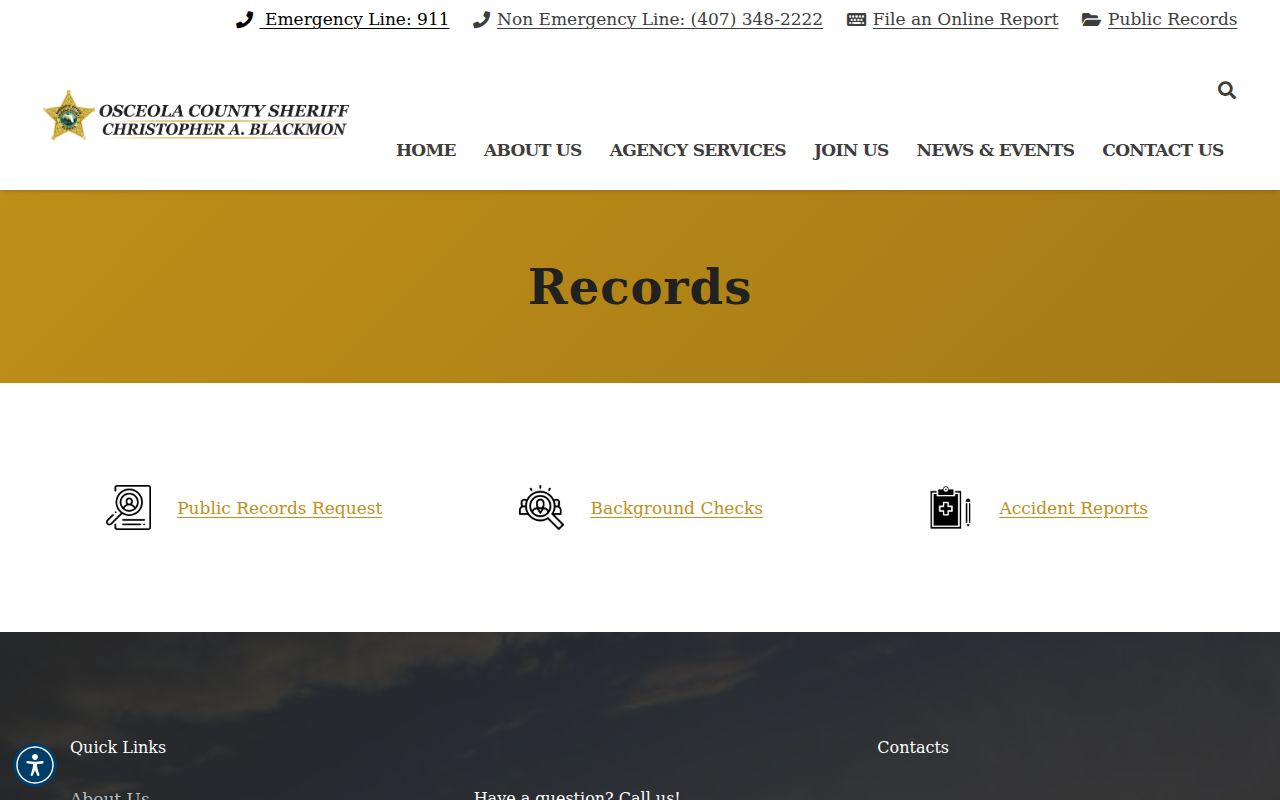
This distinction prevents a request for a police narrative from being sent to the court-file custodian.
Inside an Osceola County Case File
A court file is built around the filed case, not the jail intake. It can show the State of Florida and defendant as parties, lawyers of record, each charge, scheduled hearings, motions, pleas, judgment, sentence, costs, and closure. Read counts one by one. A dismissal on one count does not decide the outcome of another count in the same file.
| Case number and court | Identifies the division, filing year, type, and assigned file. |
|---|---|
| Charging document | The information, indictment, or complaint states the filed allegations. |
| Docket entries | A dated log of filings, notices, motions, hearings, warrants, and orders. |
| Hearing dates | Published event time, type, judge or division, and location. |
| Disposition and judgment | The outcome for each count, including plea, dismissal, acquittal, or adjudication. |
| Sentence and conditions | Confinement, probation, costs, restitution, and other entered terms. |
Reading Osceola Court Outcomes
Florida disposition words carry distinct meanings. A browser status such as “closed” does not by itself mean conviction, dismissal, or sealing. Open the events and judgment for each count. If the shorthand is unclear, obtain the filed order rather than guessing from a label.
- Nolle prosequi
- The State Attorney formally chose not to continue a charge.
- Adjudication withheld
- The court withheld formal adjudication after a plea or finding, subject to law and conditions. It is not a dismissal.
- Dismissal
- A charge ended by court action.
- Disposition
- The recorded outcome of a charge or case.
- Capias
- A court writ directing that a person be taken into custody.
How an Osceola Criminal Case Moves
After arrest and intake, initial appearance addresses probable cause, counsel, release, and conditions. County guidance lists typical sessions in the early afternoon on weekdays and late morning on weekends and holidays, though the court controls the actual schedule. The State Attorney then decides whether and what to file. Arraignment follows a filed charge. Discovery, motions, and talks may lead to a plea or trial. A qualifying plea or conviction leads to sentencing, and an appeal goes to the proper appellate court.
Case flow: Charges Filed › Arraignment › Pretrial › Plea or Trial › Disposition › Sentencing
Restricted Osceola Court Images
A docket entry can be public even when its linked image is not available from home. Florida court-access rules protect sealed matters, victim and minor data, personal identifiers, and other confidential material. Remote access may also be narrower than lawful counter inspection. Note the case number, document title, and docket date, then ask the Clerk whether a public redacted copy exists.
The Clerk can explain the request channel but cannot release exempt content. Ask for segregable public portions when only part of a document is protected. Florida Rule of General Practice and Judicial Administration 2.420 governs confidential court records, while the state constitution and Chapter 119 set the broader access framework. A missing image is not proof that the event never occurred.
Osceola Problem-Solving Court Records
The Ninth Judicial Circuit lists Adult Drug Court, Veterans Court, and Mental Health Court among its problem-solving programs. Participation may affect hearings, supervision, and docket events, but it should never be inferred from an arrest charge. Verify the particular Osceola court file and the circuit program page.
These programs do not create a separate public criminal-history product. The Clerk docket remains the path to filed orders and disposition. Some treatment, health, or assessment material can remain confidential even when a related hearing entry is public. Readers reviewing their own case should compare the docket with their signed orders and ask counsel or the Clerk about any gap.
Osceola Reports Versus Court Files
The Osceola County Sheriff's Office creates reports for incidents it investigates, while the Clerk keeps documents filed in court.
A sheriff report can explain the initial allegation, but only the Osceola docket shows the filed counts and final court result.
The Clerk also explains Osceola misdemeanor jurisdiction through its official service page.
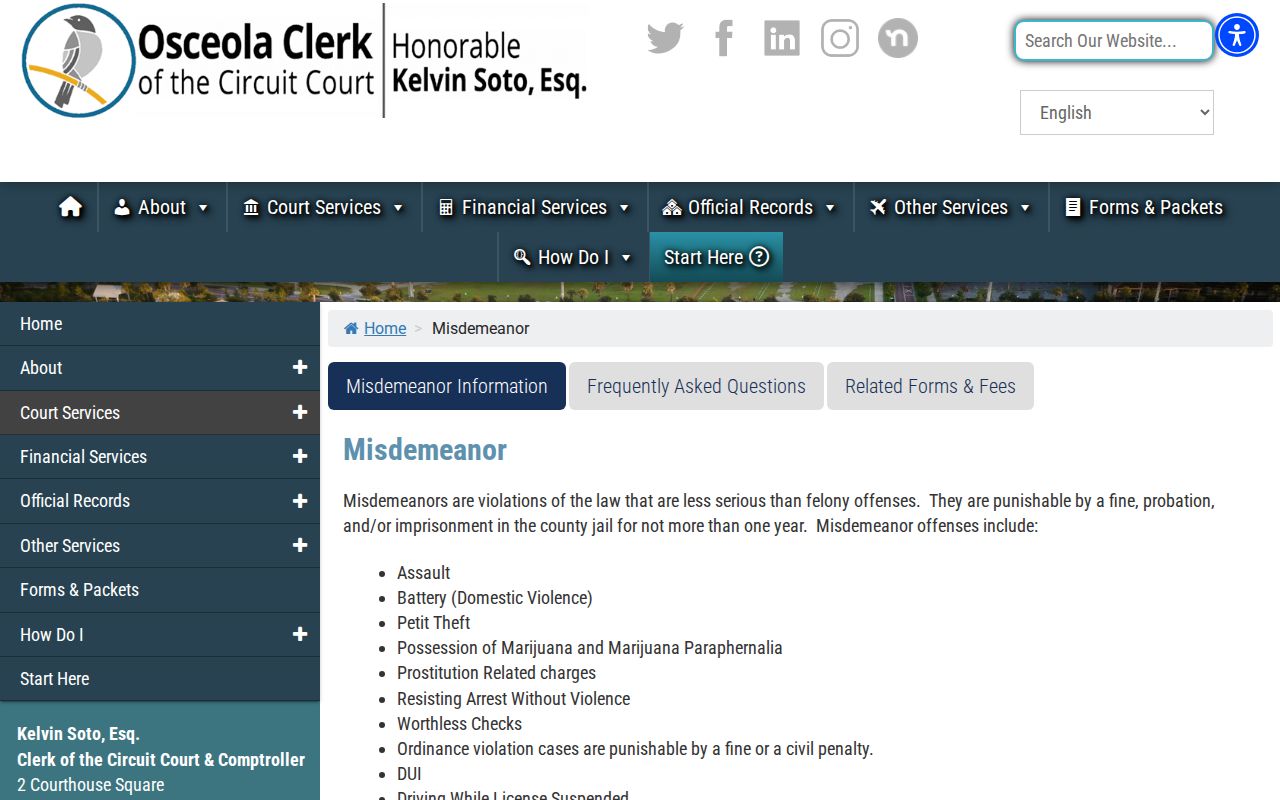
That source confirms why a city arrest for a state misdemeanor proceeds in County Court instead of a municipal criminal court.
Osceola Case Record Access Rules
Article I, section 24 of the Florida Constitution and Chapter 119 support broad access to state and local records, subject to exemptions. Court records also follow Rule 2.420. Juvenile information, victim data, protected identifiers, sealed or expunged cases, and confidential filings may be withheld or redacted. An online no-result therefore does not prove that no record exists.
Use all documented channels when the portal falls short: call case information at 407-742-3566, contact the record-search clerk at 407-742-3650, visit or write the Clerk, or submit the criminal-record request form. Florida ACIS searches appellate cases, not Osceola trial dockets. FDLE's paid name search is statewide criminal-history data, not a substitute for the Clerk's event-rich court file.